
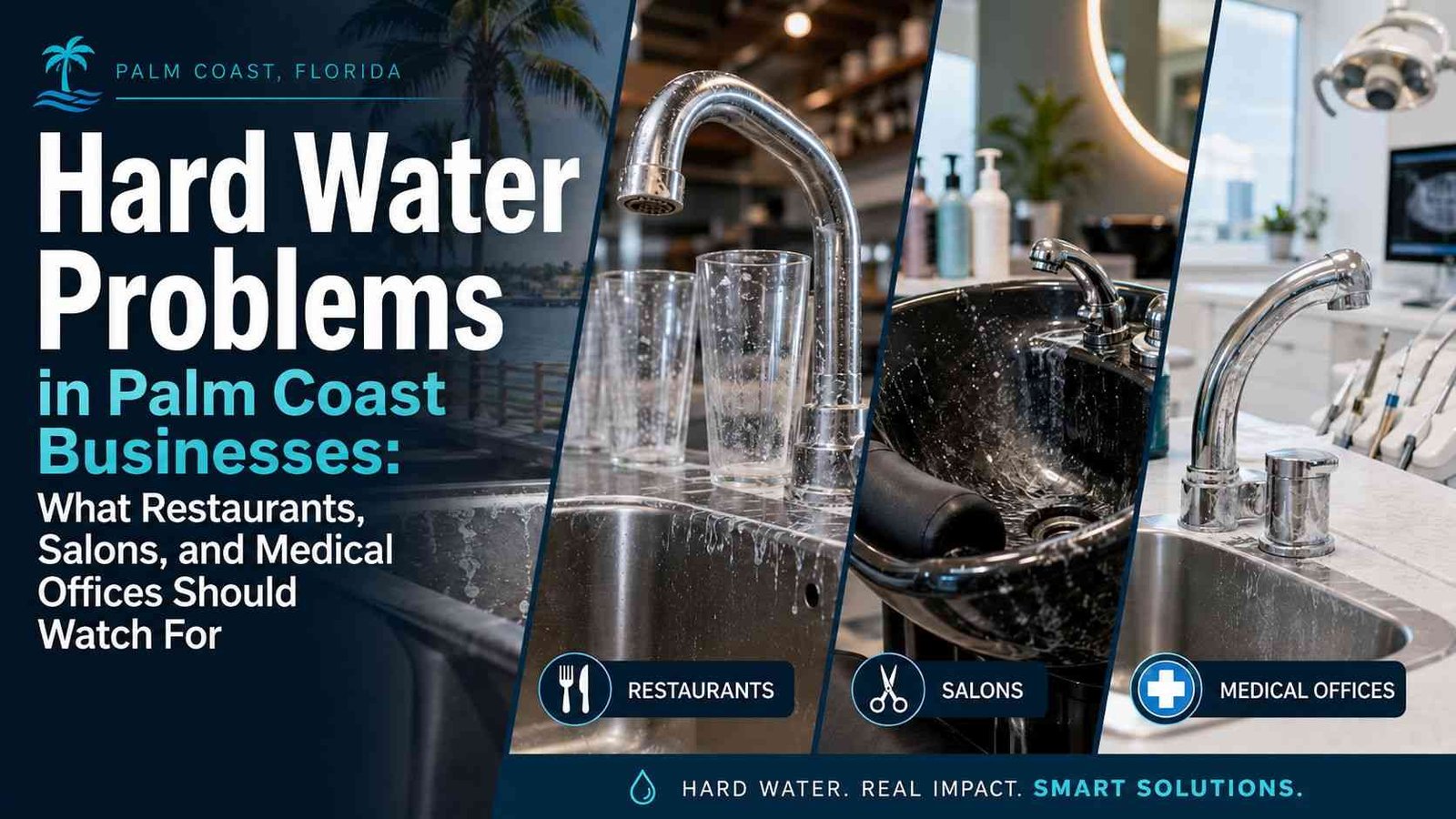
Hard water rarely announces itself with a dramatic plumbing emergency.
Instead, it works quietly.
A chalky ring appears around a faucet. Glassware starts looking cloudy. A spray nozzle loses pressure. A water heater takes longer to recover. An ice machine needs service again. A salon begins using more shampoo and cleaning products to get the same results.
One isolated issue may seem minor. Across an entire Palm Coast business, however, mineral buildup can slowly increase maintenance costs, reduce equipment efficiency, and affect the experience you provide customers and patients.
The City of Palm Coast’s 2025 Water Quality Report lists an average total hardness of 100 parts per million, or 5.8 grains per gallon, with calcium hardness averaging 80 parts per million. The city treats groundwater drawn from the Confined Surficial and Floridan aquifers using processes that include lime softening, filtration, and membrane softening.
According to the U.S. Geological Survey, water measuring between 61 and 120 milligrams per liter is generally classified as moderately hard. That places Palm Coast’s reported average squarely within the moderately hard range.
That does not mean Palm Coast water is unsafe. Water hardness is primarily an equipment, cleaning, and plumbing-performance issue, not a sign that municipal drinking water is unhealthy.
For restaurants, salons, medical offices, dental practices, hotels, gyms, and other water-dependent businesses, however, “moderately hard” can still become moderately expensive.
What Is Hard Water?
Water hardness refers mainly to dissolved calcium and magnesium.
These minerals occur naturally as groundwater moves through rock and soil. They remain dissolved while the water is flowing, but they can leave solid deposits when the water is heated, evaporates, or sits on a surface.
Those deposits are commonly called:
- Scale
- Limescale
- Mineral buildup
- Calcium deposits
- Hard-water residue
You may see white or gray crust around faucets, aerators, spray heads, heating elements, valves, and equipment connections.
The buildup you can see is only part of the problem. The same process may also be taking place inside supply lines, water heaters, boilers, dishwashers, sterilizers, and other equipment.
The USGS notes that heated hard water can form calcium-carbonate deposits that reduce equipment life, increase water-heating costs, lower water-heater efficiency, and restrict pipes.
Why Hard Water Matters More in a Commercial Building
A home may run a dishwasher once per day and serve a few people.
A commercial property may use hot water, spray fixtures, washing equipment, and specialized appliances continuously for eight, twelve, or even twenty-four hours.
That higher volume accelerates mineral accumulation.
Commercial businesses may also have:
- Larger water heaters
- Recirculation systems
- Multiple restrooms
- High-temperature dishwashing equipment
- Ice machines and beverage systems
- Specialized medical or dental equipment
- Shampoo stations
- Steam equipment
- Boilers
- High-use faucets and spray valves
- Water-cooled appliances
- Multiple tenant spaces sharing plumbing infrastructure
A small loss of efficiency across one fixture may be easy to ignore. The same loss across twenty fixtures and several major appliances can become a real operating expense.
Hard Water Warning Signs Palm Coast Businesses Should Watch For
Hard-water problems are usually gradual. Business owners often adapt to them without realizing how much performance has been lost.
Watch for these common signs.
White or Chalky Deposits
Mineral residue may appear around:
- Faucets
- Aerators
- Sink rims
- Spray nozzles
- Toilet fill components
- Drain openings
- Equipment connections
- Shampoo bowls
- Ice machine components
Frequent cleaning may remove the visible residue without stopping the buildup inside the equipment.
Cloudy Glassware and Dishes
Restaurants may notice spots or a dull film on drinking glasses, silverware, and dishes even after they pass through the dishwasher.
Hard water reacts poorly with soap and can require more detergent to achieve the same cleaning result. It is also a common cause of cloudy glassware.
Reduced Water Pressure at Individual Fixtures
When only one faucet, spray valve, or shampoo station loses pressure, the problem may be mineral buildup inside its aerator, cartridge, hose, mixing valve, or supply connection.
When multiple fixtures are affected, a plumber should check for broader plumbing restrictions, pressure-regulator problems, shutoff-valve issues, or supply-line buildup.
Water Heater Noise
Popping, rumbling, or crackling sounds from a tank-style water heater may indicate sediment or mineral deposits collecting near the heating surface.
Those deposits create a barrier between the heat source and the water. The equipment then has to work harder to transfer heat.
Longer Water-Heating Recovery Times
If a commercial water heater struggles to keep up during normal operating hours, mineral buildup may be one contributing factor.
A failing heating element, burner problem, thermostat issue, undersized unit, or high demand could also be responsible. That is why the system should be inspected rather than blamed on hard water automatically.
Frequent Equipment Repairs
Repeated problems with heating elements, valves, spray heads, pumps, solenoids, and small water passages may indicate that mineral accumulation is contributing to premature wear.
Increased Soap, Shampoo, or Detergent Use
Hard water interacts with soap, making it more difficult to produce lather and potentially leaving residue behind.
Restaurants, salons, laundries, gyms, and cleaning crews may gradually increase chemical usage without connecting the change to water hardness.
Hard Water Problems in Palm Coast Restaurants
Restaurants are among the businesses most vulnerable to mineral buildup because water touches nearly every part of the operation.
Commercial Dishwashers
Mineral deposits can accumulate on:
- Heating elements
- Wash arms
- Spray jets
- Internal screens
- Valves
- Rinse components
- Booster heaters
Restricted spray openings may reduce cleaning performance. Staff may then compensate by rerunning loads, using more chemicals, or hand-polishing cloudy glassware.
That means more labor, more water, more detergent, and more wear on the machine.
Ice Machines
Ice machines contain small valves, water lines, distribution components, pumps, and evaporator surfaces that can be affected by mineral residue.
Warning signs may include:
- Smaller or misshapen ice
- Slower production
- Cloudy ice
- Increased cleaning frequency
- Water overflowing or distributing unevenly
- Repeated valve or pump problems
Ice-machine maintenance should follow the manufacturer’s instructions. Installing the wrong type of filtration system can create new problems or violate equipment requirements.
Coffee and Espresso Equipment
Coffee brewers and espresso machines repeatedly heat water, creating favorable conditions for scale formation.
Mineral buildup may affect:
- Heating performance
- Temperature consistency
- Internal tubing
- Solenoid valves
- Steam wands
- Flow meters
- Beverage taste
A machine that takes longer to heat or delivers inconsistent volume may need professional equipment service as well as an evaluation of the incoming water.
Steam Tables and Commercial Steamers
Commercial steam equipment can develop scale on heating surfaces and internal components. The EPA notes that some commercial steam cookers use water bleed-off specifically to help manage scale accumulation.
Pre-Rinse Sprayers and Faucets
Narrow spray openings are easy targets for mineral deposits.
A sprayer that once produced a strong, even pattern may begin spraying sideways, losing force, or leaking around the head.
Replacing the spray head may restore performance temporarily, but recurring buildup suggests the incoming water should be evaluated.
Water Heaters
Restaurants often need large amounts of hot water for washing, sanitation, food preparation, and restrooms.
Scale inside a water heater can contribute to:
- Reduced efficiency
- Longer recovery times
- Higher energy use
- Overheating components
- Tank noise
- Shortened equipment life
A commercial water heater should be flushed and maintained according to the manufacturer’s requirements and the property’s actual operating conditions.
Hard Water Problems in Palm Coast Salons and Spas
For a salon, water quality is not hidden in a mechanical room. Customers experience it directly.
Shampoo Stations
Mineral deposits can restrict:
- Spray heads
- Faucet cartridges
- Mixing valves
- Flexible hoses
- Aerators
- Hot and cold supply connections
That may result in weak flow, uneven spray patterns, temperature fluctuations, or dripping fixtures.
Product Performance
Hard water can make soaps and shampoos less effective and may require more product to achieve the desired lather.
The exact effect on a client’s hair can vary based on water chemistry, products used, hair type, and treatment history. Still, persistent mineral residue can affect how a wash feels and how easily products rinse away.
Towels and Laundry
Salons, spas, massage studios, and beauty businesses wash large quantities of towels and linens.
Hard water may contribute to:
- Stiff-feeling fabrics
- Detergent residue
- Dull whites
- Increased detergent use
- Mineral accumulation inside washers
- Shorter textile life
Water Heaters
A salon may use relatively little water at the front desk but place heavy demand on hot water during fully booked periods.
If several shampoo stations operate together, even minor efficiency loss may become obvious.
Running out of hot water halfway through an appointment is not merely inconvenient. It damages the client experience.
Hard Water Concerns for Medical and Dental Offices
Medical and dental environments require a more careful distinction between ordinary plumbing concerns and clinical water-quality requirements.
A standard water softener or filtration system should never be treated as a substitute for infection-control procedures, equipment-specific treatment, or manufacturer requirements.
Dental Unit Waterlines
Dental waterlines contain narrow tubing, inconsistent flow, and periods of stagnation. These conditions can promote biofilm development.
The CDC recommends regular treatment, maintenance, and monitoring of dental unit waterlines so treatment water meets applicable drinking-water standards.
Hardness and biofilm are different issues.
Mineral scale is inorganic buildup caused largely by dissolved calcium and magnesium. Biofilm is microbial growth attached to moist surfaces. A dental office may need to address both, but the treatment methods are not interchangeable.
A commercial plumber can evaluate:
- Building supply pressure
- Shutoff valves
- Backflow devices
- Incoming plumbing
- Water heaters
- Visible scale
- Leaks
- General filtration or treatment connections
Clinical staff and equipment specialists must continue to follow CDC guidance and the dental-unit manufacturer’s waterline procedures.
Sterilizers and Autoclaves
Some sterilizers require distilled, demineralized, or otherwise specified water.
Using water that does not meet the manufacturer’s requirements may contribute to deposits, equipment faults, staining, or shortened component life.
The correct solution depends on the exact equipment. A whole-building softener does not automatically create water suitable for every sterilizer.
Examination-Room Faucets and Aerators
Mineral deposits can accumulate on fixtures in exam rooms, laboratories, break rooms, and restrooms.
In healthcare environments, fixtures must be maintained according to the facility’s infection-control policies. A visibly scaled aerator may be a plumbing maintenance issue, but it should also be handled within the facility’s established sanitation protocols.
Specialized Medical Equipment
Equipment that uses water may require:
- Reverse osmosis
- Deionization
- Distillation
- Sediment filtration
- Carbon filtration
- Softened water
- Manufacturer-specific cartridges
- Dedicated treatment loops
This is not a place for guesswork.
The equipment manufacturer’s specifications should determine the required water quality, and any treatment system should be designed around those requirements.
Other Palm Coast Businesses Affected by Hard Water
Hard-water buildup is not limited to the three industries above.
It may also affect:
- Hotels
- Fitness centers
- Laundromats
- Car washes
- Veterinary clinics
- Assisted-living facilities
- Schools and childcare centers
- Office buildings
- Bakeries
- Grocery stores
- Convenience stores
- Commercial kitchens
- Property-management portfolios
The more water a business heats, sprays, evaporates, or runs through narrow components, the more important water treatment and preventive maintenance become.
Does Every Palm Coast Business Need a Water Softener?
No.
Palm Coast’s average hardness is moderately hard, not extremely hard. Some businesses may operate successfully with routine maintenance and point-of-use filtration. Others may benefit from softening, scale reduction, reverse osmosis, or a combination of systems.
The right recommendation depends on:
- Actual water test results at the property
- Daily water usage
- Equipment specifications
- Hot-water demand
- Pipe size and layout
- Existing filtration
- Available installation space
- Drain access
- Maintenance capacity
- Sodium or water-quality requirements
- Local plumbing and backflow requirements
- Whether treatment is needed building-wide or only at one appliance
Installing a large water softener simply because scale exists can be like buying a dump truck because you need to move one couch. It may work, but it may not be the smartest or most efficient solution.
Commercial Water-Treatment Options
A professional evaluation may lead to one or more of the following recommendations.
Cartridge Filtration
Cartridge systems may reduce sediment or address specific equipment needs depending on the filter media.
A basic sediment or carbon filter does not remove hardness minerals unless it is specifically designed and certified for scale reduction or softening.
Water Softening
Traditional ion-exchange softeners replace calcium and magnesium ions with other ions, commonly sodium or potassium.
Water softeners can help protect appliances in areas with hard water, but they require correct sizing, regeneration settings, drainage, salt maintenance, and ongoing service.
Scale-Reduction Systems
Some systems are designed to reduce how minerals form or adhere as scale without removing all hardness.
Their performance and suitability depend on the equipment, flow rate, water chemistry, and product certification.
Reverse Osmosis
Reverse-osmosis systems can reduce dissolved minerals and other substances for selected applications.
They are commonly installed at the point of use rather than treating every gallon entering a large commercial building.
RO systems create reject water and require adequate pressure, drainage, storage, and maintenance.
Equipment-Specific Treatment
Ice machines, coffee equipment, steam appliances, dental systems, and sterilizers may each require different treatment.
One filter serving every appliance is not always appropriate.
Why Water Testing Should Come Before Equipment Selection
The citywide average is useful, but it does not tell you everything happening inside a specific building.
Conditions may vary due to:
- Building plumbing materials
- Water-heater condition
- Stagnant sections of piping
- Existing treatment equipment
- Poorly maintained filters
- Pressure problems
- Private wells
- Tenant improvements
- Cross-connections
- Equipment-specific contamination
- Localized corrosion or sediment
A commercial water evaluation may include hardness testing and, where appropriate, tests for iron, pH, total dissolved solids, chlorine, or other parameters related to the intended treatment system.
Medical, dental, food-service, or laboratory applications may require additional testing through qualified laboratories or equipment specialists.
When to Call a Commercial Plumber
Contact a commercial plumber in Palm Coast when you notice:
- Recurring mineral deposits on fixtures
- Low pressure at multiple water-using stations
- Water-heater noise or slow recovery
- Frequent replacement of faucet cartridges or spray heads
- Leaking equipment connections
- Repeated scale-related appliance repairs
- Cloudy restaurant glassware despite proper chemical settings
- Shampoo stations losing flow
- An existing softener that is not working correctly
- Water-treatment equipment that is leaking or bypassed
- Rust-colored staining that may indicate an issue other than hardness
- Unexplained changes in water pressure, taste, odor, or appearance
Hard water may be part of the problem, but it should not become the catch-all explanation for every plumbing symptom.
A clogged aerator is one thing. A failing pressure regulator, corroded pipe, hidden leak, or undersized supply line is another.
Proper diagnosis matters.
Protect Your Equipment Before Scale Becomes an Expensive Problem
Hard water usually does not shut a business down in one dramatic moment.
It takes the slow road.
A little scale narrows a spray opening. A heating element works slightly harder. A valve becomes less reliable. Employees use more detergent. Equipment needs service more often. Eventually, the business is paying for the same water problem from five different budget lines.
Flagler County Plumber provides commercial plumbing services in Palm Coast for restaurants, salons, medical offices, dental practices, retail properties, professional offices, and other local businesses.
Our team can evaluate commercial fixtures, water heaters, supply lines, pressure concerns, and water-treatment needs, then recommend a practical solution based on how your business actually uses water.
Whether you need commercial water filtration in Palm Coast, water-softener installation, equipment connections, water-heater service, or help diagnosing recurring mineral buildup, address the problem before it starts eating through your maintenance budget.
Call Flagler County Plumber today to schedule a commercial plumbing and water-treatment evaluation for your Palm Coast business.

