
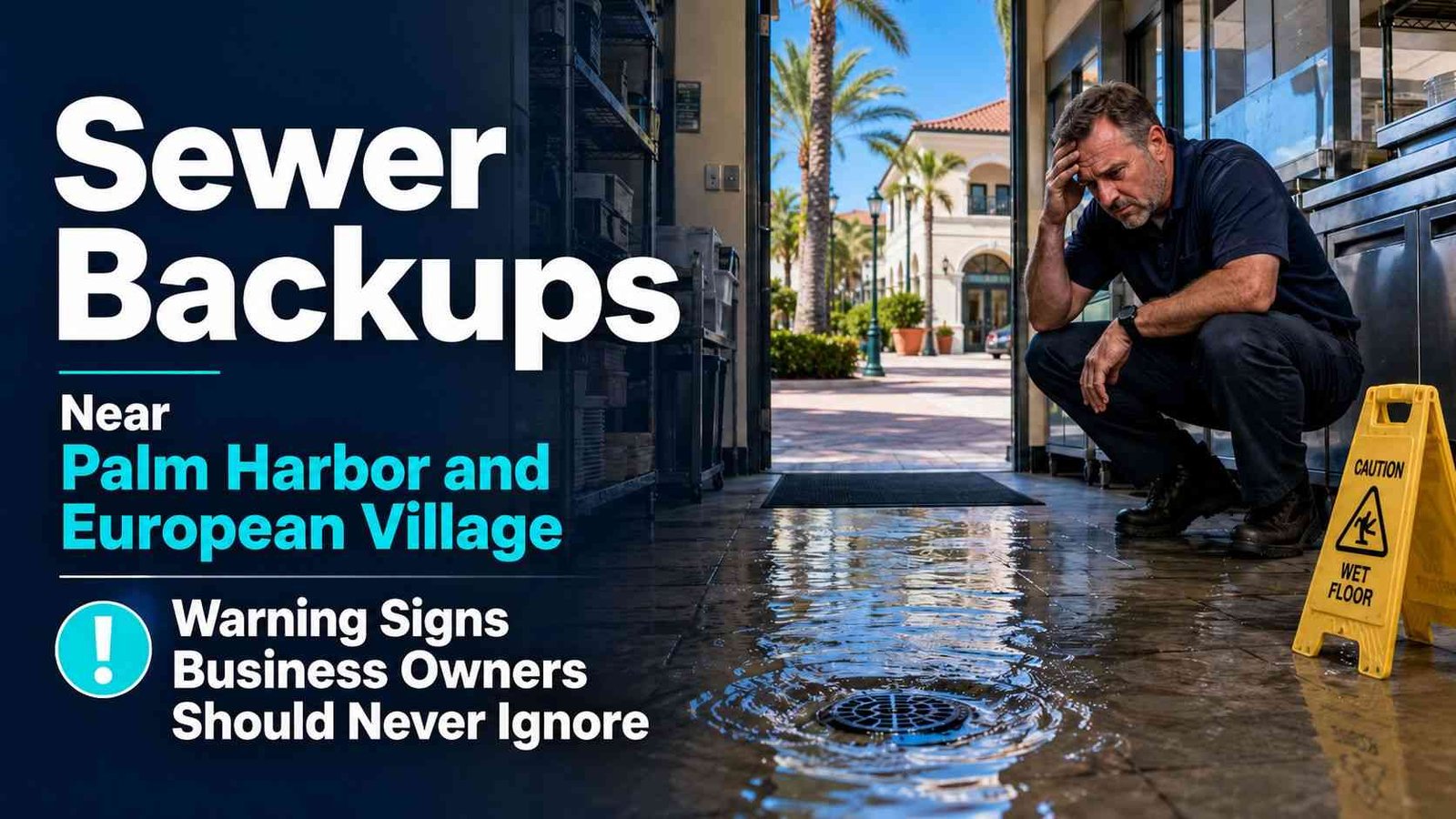
A sewer backup does not care whether your restaurant is packed, your salon is fully booked, or your office has patients waiting.
Once wastewater begins rising through a floor drain, toilet, sink, or cleanout, normal business operations can stop almost immediately.
For businesses near Palm Harbor Parkway, European Village, Club House Drive, and the surrounding commercial properties, the biggest mistake is waiting for sewage to appear before taking a drainage problem seriously.
Commercial sewer backups usually send warnings first.
The warning may be a restroom toilet that keeps clogging, a floor drain that smells worse after heavy rain, or several fixtures that drain slowly at the same time. These symptoms can seem manageable until a busy period places more demand on the plumbing system and exposes the full blockage.
Recognizing the early signs gives business owners a chance to act before a plumbing problem becomes a sanitation emergency, property-damage claim, or forced closure.
Why Sewer Backups Are So Disruptive for Palm Coast Businesses
A slow drain is inconvenient. A sewer backup is a business interruption.
Wastewater may contain bacteria, organic waste, cleaning chemicals, grease, and other contaminants. When it enters a commercial space, it can affect:
- Flooring
- Drywall
- Cabinets
- Merchandise
- Kitchen equipment
- Salon stations
- Medical or office areas
- Electrical components near the floor
- Customer restrooms
- Storage rooms
- Employee workspaces
The visible cleanup is only one part of the cost.
A business may also face lost appointments, canceled reservations, damaged inventory, employee downtime, odor removal, sanitation work, and possible inspections before the affected area can reopen.
That is why recurring drainage symptoms should never be treated as “just another clog.”
Why the Palm Harbor and European Village Area Requires a Commercial Plumbing Mindset
European Village is a recognizable mixed-use destination near Palm Harbor Parkway and the Intracoastal Waterway. The surrounding area includes restaurants, shops, offices, lodging, residential units, marinas, and other properties that may experience varying levels of plumbing demand throughout the day.
City events have also used European Village as a shuttle location because of its access to the Palm Harbor and Intracoastal area, reinforcing its role as a well-trafficked local destination.
Mixed-use and multi-tenant properties can present more complicated drainage problems than a standalone house.
Depending on the building’s plumbing design:
- Several tenants may connect to a common private sewer line
- Upper and lower units may share vertical drain stacks
- Restaurants may add grease and food waste to shared infrastructure
- Public restrooms may receive heavy intermittent use
- Older tenant improvements may have changed the original plumbing layout
- Cleanouts may be difficult to locate or access
- One tenant may experience symptoms caused by a restriction farther downstream
This does not mean shared plumbing is automatically defective. It means the diagnosis must consider the entire drainage pattern rather than focusing only on the first fixture that backs up.
Seven Warning Signs of a Developing Commercial Sewer Backup
1. Several Fixtures Are Draining Slowly
A single slow hand sink may have a localized clog.
When toilets, sinks, floor drains, and other fixtures begin slowing down together, the restriction may be located in a larger branch drain or the building’s main sewer line.
Pay attention to timing.
When drains work during quiet periods but struggle during lunch service, evening traffic, or a fully booked day, the line may already be partially restricted. Increased wastewater flow simply exposes the problem.
2. Toilets Keep Clogging Without an Obvious Cause
A toilet that clogs once may have received too much paper or an inappropriate item.
A commercial toilet that repeatedly clogs, especially when nearby fixtures also act strangely, deserves a deeper inspection.
Possible causes include:
- A blockage in the toilet trap
- A restricted branch line
- A main sewer obstruction
- Improperly flushed wipes or hygiene products
- Scale buildup
- Damaged piping
- Poor drainage slope
- A venting problem
- A foreign object lodged in the line
Repeatedly plunging the toilet may reopen a narrow passage without removing the underlying obstruction.
3. Water Appears in a Floor Drain When Another Fixture Is Used
This is one of the clearest warning signs of a downstream blockage.
For example:
- A floor drain bubbles when a toilet flushes
- Water rises near a restroom drain when a sink empties
- A kitchen floor drain backs up when the dishwasher discharges
- Wastewater appears in one tenant’s space when another area uses plumbing
Wastewater is looking for the lowest available exit. In many commercial buildings, that exit is a floor drain.
Do not continue testing the system by running more water. Every additional gallon can increase the contamination area.
4. Drains Gurgle or Release Air Bubbles
Gurgling occurs when wastewater and trapped air are struggling to move through the drainage system.
You may hear it from:
- Toilets
- Floor drains
- Break-room sinks
- Kitchen sinks
- Shampoo stations
- Mop sinks
- Utility sinks
One isolated gurgle does not automatically mean the sewer line is failing. Persistent gurgling across multiple fixtures, however, should not be ignored.
5. Sewer Odors Keep Returning
A dry drain trap can allow sewer gas to enter a building. This often occurs in floor drains or fixtures that are rarely used.
However, persistent odors may also result from:
- Waste accumulating inside a restricted line
- A damaged drain or vent pipe
- A loose cleanout cap
- A failing wax ring beneath a toilet
- Grease and organic buildup
- Improper venting
- Wastewater leaking below the building
- A partially blocked sewer line
Masking the smell with air freshener is not a repair. It is perfume on a warning light.
6. The Outdoor Sewer Cleanout Is Overflowing
A sewer cleanout provides access to the building’s drain or sewer line.
If wastewater is standing around the cleanout or escaping after the cap is removed, there may be a downstream blockage.
Palm Coast advises property owners to keep sewer cleanout caps properly attached and undamaged. A loose, missing, or cracked cap can allow rainwater, irrigation water, debris, insects, or small animals to enter the sewer connection and contribute to backups or damage.
Business owners and property managers should know where their cleanouts are located and keep them visible. Landscaping, pavement changes, stored materials, or tenant improvements should not bury or obstruct access.
7. Problems Become Worse During Heavy Rain
Heavy rainfall can expose vulnerabilities in both public and private wastewater systems.
In September 2024, Palm Coast reported that 7 to 10 inches of rain over five days caused its wastewater plants to process approximately 6 million additional gallons in one day.
Rain-related backups may be influenced by:
- Damaged or missing cleanout caps
- Cracked private sewer pipes
- Improper stormwater connections
- Groundwater entering defective lines
- Overloaded wastewater infrastructure
- Low areas where water accumulates
- Lift-station or utility-system problems
- Private drain lines that were already partially blocked
Rain does not create every clog. Sometimes it reveals the clog that was already waiting.
What Causes Commercial Sewer Backups?
A proper repair begins by identifying the actual cause. Clearing a line without understanding why it clogged may provide only temporary relief.
Grease and Food Waste
Restaurants, cafés, bakeries, and commercial kitchens can develop thick grease deposits inside drain and sewer lines.
Grease may enter as a warm liquid but cool and harden inside the piping. Food particles then stick to the buildup, gradually narrowing the pipe.
A cable machine may punch a temporary opening through the material. Depending on the line’s condition, hydro jetting may be needed to remove buildup from the pipe walls more thoroughly.
Wipes and Paper Products
Products labeled “flushable” do not always break apart quickly enough to move through commercial plumbing without problems.
Common blockage materials include:
- Disinfecting wipes
- Baby wipes
- Paper towels
- Feminine hygiene products
- Shop towels
- Cleaning cloths
- Excessive toilet paper
- Disposable gloves
Commercial restrooms serve people who may not care what happens after they flush. Clear signage, covered waste bins, and employee monitoring can reduce the risk.
Foreign Objects
Phones, utensils, toys, air fresheners, mop heads, plastic packaging, and other items can enter commercial drains and toilets.
When a foreign object becomes lodged in the line, paper and waste can collect around it until the pipe closes.
Damaged or Misaligned Pipes
A recurring blockage may indicate more than accumulated debris.
Possible structural problems include:
- Cracked pipe
- Separated joint
- Collapsed section
- Sagging or bellied line
- Improper slope
- Corrosion
- Offset connection
- Construction debris
- Intruding roots where conditions allow
A sewer camera inspection can help distinguish between a dirty line and a damaged one.
Heavy Plumbing Demand
Restaurants, event spaces, offices, salons, medical facilities, and mixed-use properties may create large bursts of wastewater.
A partially blocked line may seem normal early in the morning and fail when several fixtures begin operating simultaneously.
High demand is often the trigger, not the root cause.
Shared Private Sewer Lines
In a multi-tenant property, several businesses may connect to a common private sewer before the line reaches the municipal system.
This creates important questions:
- Which fixtures are affected?
- Are neighboring tenants experiencing symptoms?
- Where does each branch connect?
- Who is responsible for the shared line?
- Is the blockage inside a tenant space, beneath the building, or outside?
- Is the problem on private property or within the utility system?
Property managers should preserve plumbing plans and know which contractors have modified the building.
Municipal Wastewater or Lift-Station Problems
Not every backup begins inside the building.
Palm Coast Utilities operates the city’s wastewater infrastructure and provides a process for reporting sewer concerns. The city directs customers experiencing backups or utility-related issues to submit a case through Palm Coast Connect or contact Utility Customer Service.
During major storms and power disruptions, the city has warned that wastewater-system capacity can become strained and backups may occur.
A commercial plumber can inspect the private side of the system and help determine whether the evidence points toward a building blockage or a broader utility issue.
Private Plumbing Problem or City Sewer Problem?
This is one of the most important questions during a backup.
In general, the property owner is responsible for private plumbing and sewer piping serving the building, while the city handles public wastewater infrastructure. The exact dividing point and responsibility can vary based on the property and connection.
Signs that may suggest a private plumbing problem include:
- Only one fixture or tenant is affected
- A cleanout closer to the building is holding wastewater
- The problem follows a history of grease or wipes
- Neighboring properties have no symptoms
- A camera identifies damage within the private line
- The blockage is cleared from a private cleanout
Signs that may suggest a broader utility issue include:
- Several nearby properties experience backups simultaneously
- The building’s private line appears open
- The problem begins during severe rain or a known utility disruption
- Wastewater is overflowing from public infrastructure
- The city confirms a system problem
These are clues, not final proof.
A plumber should not blame the city without inspecting the private system. Likewise, a business should not keep paying to clear the same line if evidence suggests the problem lies beyond its property.
What to Do When Sewage Begins Backing Up
Once wastewater enters the building, speed matters.
Stop Using Water Immediately
Stop flushing toilets and using sinks, dishwashers, washing machines, mop sinks, and other connected equipment.
Palm Coast similarly advises customers experiencing a sewer backup to stop water use while the problem is being addressed.
Keep People Away From the Area
Block access to contaminated rooms or walkways.
Do not allow employees or customers to walk through wastewater and carry contamination into clean areas.
Protect Nearby Equipment When Safe
Turn off or relocate vulnerable equipment only when it can be done without entering contaminated water or creating an electrical hazard.
Never step into standing wastewater near energized equipment.
Do Not Pour Chemicals Into the Drains
Chemical drain cleaners are unlikely to resolve a main sewer blockage and may create a dangerous exposure for plumbers and cleanup workers.
Call a Commercial Plumber
Tell the plumber:
- Which fixtures are affected
- When the problem began
- Whether nearby tenants have symptoms
- Whether it followed heavy rain
- Whether the cleanout is overflowing
- Whether the building has a history of backups
- What type of business occupies the property
These details can help the technician arrive prepared.
Notify the Property Manager
Tenants should notify the landlord or property manager immediately, particularly when shared plumbing may be involved.
Contact Palm Coast Utilities When Appropriate
When the problem appears connected to city wastewater infrastructure, create a case through Palm Coast Connect or contact Palm Coast Utility Customer Service.
Palm Coast Connect allows customers to report utility concerns and track the submitted case.
Arrange Professional Cleanup
Plumbing repair restores drainage. It does not automatically sanitize contaminated building materials or contents.
Depending on the severity, a qualified remediation or cleanup company may be necessary.
How a Commercial Plumber Diagnoses the Backup
Fixture and Drainage Evaluation
The plumber begins by identifying which fixtures are affected and how they connect.
This helps determine whether the blockage is local, within a branch line, or farther downstream.
Cleanout Inspection
Accessible cleanouts allow the plumber to evaluate flow and enter the line with cleaning or inspection equipment.
Mechanical Drain Cleaning
A commercial drain machine can break apart many obstructions and restore flow.
The material recovered from the line may provide clues about the cause.
Hydro Jetting
Hydro jetting uses high-pressure water to clean grease, sludge, and deposits from the pipe walls.
It may be recommended for recurring commercial buildup when the pipe is suitable for the process.
Sewer Camera Inspection
A sewer camera can reveal:
- Remaining buildup
- Cracks
- Separated joints
- Sagging sections
- Corrosion
- Foreign objects
- Improper connections
- Areas where water remains standing
A camera inspection is especially valuable when backups keep returning.
However, a camera should generally be used after enough flow has been restored to see the pipe clearly. Sending a camera into opaque wastewater may reveal little more than dirty water.
Locating the Defect
Camera equipment may be paired with a locator to identify the approximate position and depth of a damaged section.
This reduces unnecessary excavation and helps plan targeted repairs.
How Business Owners Can Prevent Future Sewer Backups
Create a Preventive Drain-Maintenance Schedule
Do not wait for the calendar to be set by emergencies.
Maintenance frequency should be based on:
- Business type
- Plumbing usage
- Grease exposure
- Number of restrooms
- Tenant count
- Pipe condition
- Backup history
- Manufacturer requirements for connected equipment
Keep Sewer Cleanouts Accessible
Mark their locations and inspect the caps periodically.
Do not cover cleanouts with concrete, landscaping, storage containers, or permanent fixtures.
Train Employees
Employees should know:
- What cannot be flushed
- What cannot enter kitchen drains
- Where shutoff valves are located
- How to report slow drains
- Why repeated plunging is not a complete repair
- Who to contact after hours
Install Appropriate Waste Containers
Restrooms need visible, covered disposal bins. Kitchens need proper containers for grease and food waste.
Make the correct disposal option easier than flushing the wrong item.
Investigate Every Recurring Backup
A line that clogs every few months is not “just one of those things.”
It may need better cleaning, a camera inspection, pipe repair, grease-management changes, or a new maintenance schedule.
Coordinate Across Tenants
Property managers should encourage businesses to report drainage symptoms early.
One tenant’s slow drain may be the first warning of a shared-line problem affecting the entire property.
Do Not Wait for Wastewater to Reach the Floor
Commercial sewer backups rarely become cheaper when ignored.
The safest time to address the problem is when drains begin slowing, toilets start gurgling, or odors repeatedly return. Once sewage enters the building, the repair is only one part of the expense.
Flagler County Plumber provides commercial plumbing services in Palm Coast for restaurants, shops, offices, salons, medical facilities, mixed-use properties, and other local businesses near Palm Harbor Parkway and European Village.
Our team can diagnose recurring drain problems, clear commercial sewer lines, perform sewer camera inspections, evaluate private plumbing, and help determine whether a backup may involve the municipal wastewater system.
Whether you need commercial drain cleaning in Palm Coast, hydro jetting, sewer-line repair, or an emergency plumber near European Village, act before the next busy period pushes a restricted line past its limit.
Call Flagler County Plumber today to schedule commercial sewer and drain service for your Palm Coast property.

