
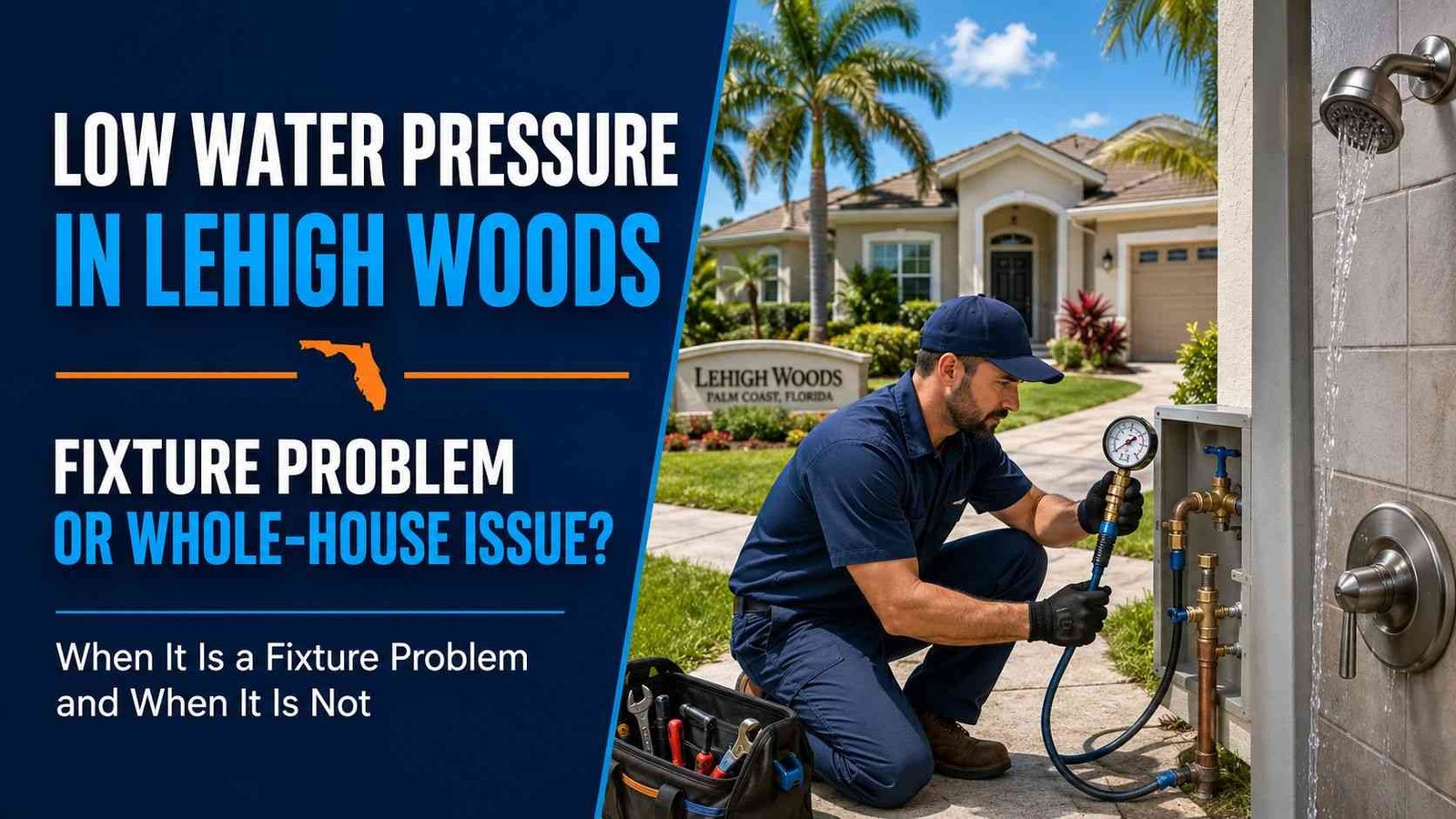
A shower that suddenly feels weak can be frustrating.
But before assuming the entire house has a serious plumbing problem, take a closer look at where the pressure loss is happening.
Low water pressure at one kitchen faucet may be caused by a clogged aerator. Weak flow throughout an entire Lehigh Woods home could point toward a partially closed valve, water-treatment equipment, a pressure regulator, a hidden leak, or a problem involving the utility supply.
The symptoms may feel similar, but the repairs can be very different.
For homeowners in Lehigh Woods, also commonly known as Palm Coast’s R Section, the fastest path to the right solution is determining whether the problem affects one fixture, one part of the house, only the hot water, or the entire plumbing system. The City of Palm Coast’s own mapping identifies Lehigh Woods as the R Section.
What Does Low Water Pressure Actually Mean?
Water pressure is the force that moves water through the plumbing system.
Water flow is the amount of water coming through the fixture.
Homeowners often use the terms interchangeably, but a faucet can have poor flow even when the home’s underlying pressure is normal.
For example, mineral buildup inside a faucet aerator may restrict the amount of water leaving the spout. The pressure behind the blockage may be perfectly adequate, but the faucet still feels weak.
That distinction matters because cleaning one small component is very different from diagnosing a whole-house pressure problem.
Start With One Important Question
Before calling a plumber, determine how much of the home is affected.
Ask:
- Is only one faucet weak?
- Is one bathroom affected?
- Is the problem limited to hot water?
- Are both hot and cold water weak?
- Does pressure drop only when two fixtures run together?
- Is the entire home affected?
- Did the change happen suddenly or gradually?
- Are nearby homes experiencing the same problem?
These answers can quickly narrow the possibilities.
When Low Water Pressure Is Probably a Fixture Problem
When only one faucet, showerhead, or appliance has weak flow, the problem is usually close to that fixture.
That is generally good news because localized problems are often easier and less expensive to correct.
1. A Clogged Faucet Aerator
The aerator is the small screened component attached to the end of a faucet spout.
Its job is to shape the stream, reduce splashing, and mix air with the water. Over time, it can collect:
- Mineral deposits
- Sediment
- Rust particles
- Plumbing debris
- Small pieces of deteriorated washers or seals
When the aerator becomes restricted, the faucet may produce a weak, uneven, or sideways stream.
How to check it
Unscrew the aerator carefully and inspect the screen. Run the faucet briefly with the aerator removed.
If the flow improves significantly, the restriction is probably inside the aerator.
Clean or replace the component before assuming the home has a larger pressure problem.
Place a towel over the drain while removing small parts. Otherwise, your five-minute repair can become a ten-minute search through the drain trap.
2. Mineral Buildup in a Showerhead
Palm Coast’s municipal water averages approximately 100 milligrams per liter of hardness, placing it in the moderately hard range. That can contribute to scale around aerators and showerhead openings over time.
A showerhead clogged with mineral deposits may:
- Spray unevenly
- Send water in several directions
- Lose flow gradually
- Produce weak pressure from some openings
- Continue dripping after use
Remove and clean the showerhead according to the manufacturer’s directions.
White vinegar may help dissolve deposits on some fixtures, but it can damage certain finishes and materials. Check the manufacturer’s instructions first.
3. A Worn Faucet Cartridge
Many modern faucets and shower valves use cartridges to control flow and temperature.
As the cartridge wears or collects debris, it may restrict water movement.
Possible signs include:
- Weak flow from one fixture
- Difficulty adjusting temperature
- A stiff handle
- Dripping after shutoff
- Uneven hot and cold flow
- Pressure changes while moving the handle
A cartridge problem is usually isolated to the affected fixture.
However, the correct replacement part must match the faucet or valve. Forcing the wrong component into place is a reliable way to turn a small repair into a weekend plumbing adventure nobody requested.
4. A Partially Closed Fixture Shutoff Valve
The shutoff valves beneath a sink or behind a toilet control water to that fixture.
If a valve was partially closed during a repair, cleaning, renovation, or appliance installation, the fixture may receive reduced flow.
Check whether the valve is fully open, but do not force it.
Older or corroded shutoff valves can break or begin leaking when disturbed. If the handle is frozen, heavily rusted, or dripping, have a plumber replace it.
5. A Kinked or Restricted Supply Line
Flexible supply lines connect many faucets, toilets, dishwashers, washing machines, and appliances to the plumbing system.
A line may become kinked, twisted, crushed, or internally deteriorated.
This may cause:
- Weak flow at one fixture
- Slow toilet refilling
- Poor appliance performance
- Uneven hot or cold water
- Whistling sounds
Inspect accessible lines carefully.
Do not reuse damaged or heavily corroded supply lines. A restricted hose is annoying. A burst hose is a flooring renovation you did not budget for.
When One Bathroom Has Low Pressure
When several fixtures in one bathroom are weak but the rest of the home seems normal, the problem may involve the branch line serving that area.
Possible causes include:
- A partially closed local valve
- Debris introduced during repairs
- Corrosion or scale inside branch piping
- A damaged pipe
- Improper plumbing alterations
- A shared shower-valve problem
- A restriction affecting one side of the home
Check whether both hot and cold water are affected.
If only hot water is weak, focus on the hot-water supply. If both are weak, the restriction may be farther upstream.
When Only the Hot Water Pressure Is Low
Weak hot-water flow throughout the home usually points toward the water heater or hot-water piping rather than the city supply.
Possible causes include:
- A partially closed water-heater valve
- Sediment or debris
- Restricted water-heater connectors
- A failing mixing valve
- Scale inside equipment
- Corrosion in hot-water piping
- A water-heater installation problem
Compare hot and cold flow at several fixtures.
If cold water is strong but hot water is weak throughout the house, the problem is likely somewhere after the cold-water line enters the water heater.
Check the Water Heater Shutoff Valve
The cold-water inlet valve controls water entering the water heater.
If it is partially closed, damaged, or restricted, hot-water flow throughout the home may suffer.
Do not force an older valve.
A corroded valve that breaks can release pressurized water in the garage. That is not the moment to learn where the main shutoff is located.
Restricted Water-Heater Connectors
Some water heaters use flexible supply connectors.
Internal deterioration, debris, installation problems, or damaged liners may restrict flow even when the exterior looks normal.
The City of Palm Coast has specifically published guidance concerning certain water-heater supply-line connectors and also notes that plumbing materials within the home can affect water after it passes the utility’s point of delivery.
A plumber can test flow before and after the equipment to determine whether the restriction involves the connector, valve, heater, or hot-water piping.
When the Entire House Has Low Water Pressure
Weak pressure throughout the home requires a broader investigation.
The problem may be located:
- Near the water meter
- At the main shutoff valve
- Inside a pressure regulator
- Within a water softener or filter
- In the main supply line
- In the home’s distribution piping
- At a hidden leak
- Within the public utility system
The first step is determining whether the problem belongs to the home or the utility.
1. The Main Shutoff Valve Is Not Fully Open
The main shutoff controls water entering the home.
It may have been partially closed during:
- Plumbing repairs
- Construction
- Irrigation work
- A water-heater replacement
- A previous leak
- Utility work
- A home inspection
A partially closed valve can restrict flow throughout the entire property.
Locate the valve and inspect its condition. Do not aggressively turn a corroded or unfamiliar valve without knowing how it operates.
Some valves require several turns, while others use a quarter-turn handle. Forcing the wrong style can damage the valve.
2. A Failing Pressure-Reducing Valve
Some homes use a pressure-reducing valve, commonly called a pressure regulator, to control incoming water pressure.
When the regulator begins failing, homeowners may experience:
- Low pressure throughout the house
- Pressure that changes unpredictably
- Strong pressure followed by weak flow
- Banging or vibrating pipes
- Pressure loss when multiple fixtures run
- Frequent fixture or supply-line problems
A plumber can test pressure before and after the regulator.
Replacing one fixture will not solve a failing whole-house regulator. That would be like changing a lamp because the electrical panel is malfunctioning.
3. A Clogged Whole-House Filter
Whole-house sediment and carbon filters can restrict water flow when their cartridges become clogged.
This is especially likely when:
- The pressure declined gradually
- The system has not been serviced
- The filter change date is unknown
- Pressure improves when the system is bypassed
- Several fixtures are affected equally
The City of Palm Coast states that privately installed water softeners, whole-house filters, and similar equipment are the homeowner’s responsibility after the water reaches the property’s point of delivery.
Check the maintenance schedule and pressure gauges if the system includes them.
Do not simply remove a cartridge and operate the housing empty unless the manufacturer allows it.
4. A Water Softener Problem
A malfunctioning or incorrectly configured water softener can also reduce flow.
Possible causes include:
- A clogged resin bed
- A blocked control valve
- Incorrect bypass position
- Improper system sizing
- Sediment accumulation
- Failed internal components
- Poor maintenance
- Frozen or restricted drain equipment
Try comparing pressure before and after the system when safe and appropriate.
A plumber or water-treatment professional can help determine whether the softener is responsible.
5. A Hidden Plumbing Leak
A pressurized leak can reduce available pressure, particularly when it is significant.
Warning signs include:
- Unexplained water usage
- A higher water bill
- Damp flooring or walls
- The sound of running water
- Warm areas on the floor
- Moisture near the foundation
- A water meter that moves when fixtures are off
- Pressure that suddenly became weak
The City of Palm Coast recommends turning off water-using fixtures and checking whether the meter’s leak indicator continues moving. A moving indicator may show that water is still flowing somewhere on the property.
A meter test can reveal hidden usage, but it cannot identify the location.
The leak could involve:
- A toilet
- Irrigation
- Pool equipment
- An outdoor line
- An appliance
- A pipe inside the wall
- A line beneath the slab
Professional leak detection may be necessary when no visible source can be found.
6. A Restricted Main Water Line
The water line between the meter and the home can become restricted or damaged.
Possible causes include:
- Pipe deterioration
- Improper sizing
- A damaged valve
- Debris
- A kinked replacement line
- Previous repairs
- Root or soil movement
- A hidden leak
Palm Coast states that the property owner is responsible for on-site water lines beginning at the discharge side of the applicable meter or backflow preventer.
That means a problem after the utility’s point of delivery may require a plumber even though it affects the entire home.
7. Undersized or Poorly Designed Plumbing
Some homes experience acceptable pressure when one fixture is used but weak performance when several fixtures operate together.
This may indicate that part of the plumbing system cannot deliver enough flow for the household’s demand.
Possible contributors include:
- Undersized supply piping
- Long plumbing runs
- Poor renovation work
- Too many fixtures on one branch
- Restrictive valves or fittings
- Improper additions
- Water-treatment equipment with insufficient flow capacity
This type of issue may have existed since construction or may have appeared after bathrooms, appliances, or treatment systems were added.
Pressure Drops Only When Multiple Fixtures Run
This symptom is important.
If one shower works well but pressure collapses when the washing machine or another shower starts, the system may have adequate static pressure but poor available flow under demand.
Possible causes include:
- Restricted main line
- Clogged filtration equipment
- Failing regulator
- Undersized piping
- Partially closed valve
- Restriction near the meter
- Excessive simultaneous demand
A plumber can measure both static and flowing pressure.
Static pressure is measured when no water is moving. Flow pressure is measured while fixtures are operating.
A healthy static reading does not prove the system performs properly when water is actually being used.
Could the City Be Causing the Low Pressure?
Yes, but do not assume that automatically.
A temporary utility-side issue may occur because of:
- Water-main repairs
- A main break
- Hydrant use
- Maintenance
- Construction
- A localized system interruption
- A broader pressure loss
Check whether neighboring homes are experiencing the same problem.
If several nearby properties suddenly lose pressure at the same time, the issue is more likely to involve the public system.
The City of Palm Coast provides a specific Palm Coast Connect reporting option for residents experiencing no water or low pressure.
A significant public-system pressure loss may also lead to a precautionary boil-water notice. The city explains that such notices may be issued after a loss of pressure caused by a main break or similar event.
What to Check Before Calling a Plumber
Complete a quick walkthrough before scheduling service.
Check one fixture
Determine whether the problem affects only one faucet or shower.
Remove the aerator
Test the faucet briefly without the aerator.
Compare hot and cold water
This can reveal whether the problem is connected to the water heater.
Check other rooms
Test fixtures in several areas of the house.
Inspect treatment equipment
Look for overdue filters, error messages, leaks, or incorrect bypass settings.
Ask a neighbor
A utility problem will often affect more than one property.
Check the water meter
Make sure water is not moving when all fixtures and equipment are off.
Note when the problem began
A sudden change points toward a failure, valve movement, leak, or utility issue. Gradual decline often suggests buildup or equipment restriction.
Do Not Judge Pressure by One Faucet Alone
One weak faucet does not prove the house has low water pressure.
Likewise, a powerful outdoor hose bib does not prove every part of the plumbing system is healthy.
Different fixtures, branch lines, valves, and equipment can produce different results.
Accurate diagnosis requires looking at the entire pattern.
When to Call a Plumber
Schedule a professional plumbing inspection when:
- The whole house has weak pressure
- Pressure changed suddenly
- Hot water is weak throughout the home
- Several fixtures are affected
- Pressure drops sharply when multiple fixtures run
- The meter shows unexplained water use
- You suspect a slab leak
- A valve is corroded or frozen
- Treatment equipment may be restricting flow
- Neighbors have normal pressure but your home does not
- The problem returns after cleaning fixtures
A plumber may evaluate:
- Static water pressure
- Flow pressure
- Main shutoff operation
- Pressure-regulator performance
- Water-heater flow
- Filter and softener restrictions
- Fixture cartridges
- Pipe condition
- Hidden leaks
- Meter-to-home supply lines
The goal is not merely to increase pressure.
The goal is to find out why the flow is weak without creating excessive pressure that damages the plumbing system.
Can Water Pressure Be Too High?
Yes.
Some homeowners respond to weak flow by trying to raise the pressure as much as possible.
That can create a different set of problems.
Excessive pressure may contribute to:
- Dripping faucets
- Running toilets
- Damaged cartridges
- Noisy pipes
- Failed supply lines
- Appliance-valve damage
- Water-heater stress
- Premature plumbing wear
The correct solution is balanced, controlled pressure with adequate flow.
More is not always better. A fire hose is powerful, but nobody wants one connected to the bathroom sink.
How to Prevent Future Pressure Problems
Homeowners can reduce the chance of recurring issues by:
- Cleaning faucet aerators periodically
- Descaling showerheads when appropriate
- Replacing filtration cartridges on schedule
- Maintaining water softeners
- Inspecting supply lines and shutoff valves
- Addressing leaks promptly
- Monitoring water usage
- Having pressure tested when symptoms appear
- Avoiding unqualified plumbing alterations
- Keeping records of equipment maintenance
Pay particular attention after renovations, appliance installations, water-heater work, or filtration-system changes.
A pressure problem that begins immediately after service may involve a valve position, debris, installation issue, or equipment restriction.
The Bottom Line for Lehigh Woods Homeowners
Low water pressure is a symptom, not a diagnosis.
When one faucet is weak, start with the aerator, cartridge, shutoff valve, or supply line.
When only the hot water is weak, inspect the water heater and hot-water system.
When the entire house is affected, consider the main valve, pressure regulator, filtration equipment, water softener, hidden leaks, the main supply line, and the public utility system.
The pattern tells the story.
Do not replace half the plumbing system because one showerhead needs cleaning. But do not keep cleaning fixtures when the entire house is clearly warning you about something larger.
Need Help With Low Water Pressure in Lehigh Woods?
Flagler Plumbing provides water-pressure testing, fixture repairs, leak detection, water-heater service, filtration-system evaluations, and general plumbing repairs throughout Lehigh Woods and the surrounding Palm Coast area.
If your home has weak flow, changing pressure, or a sudden whole-house pressure problem, we can identify whether the issue begins at a fixture, inside the plumbing system, or near the property’s water supply.
Contact Flagler Plumbing to schedule a water-pressure inspection for your Lehigh Woods home.

